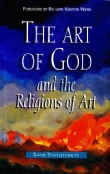
Art of God the book
...............
Reviews of The art of God

ARTS CENTRE GROUP, LONDON
‘For anyone interested in art, this is a ‘must read’. If you know something about the principle art movements and have looked at modern art and want to know more, this book will respond to your unanswered questions from a Christian perspective. You may not agree with everything stated but the book’s message has a clear ring of authenticity.

‘Thistlethwaite writes with persistent analytical stamina and grapples confidently with the meanings behind the art he considers…If you appreciated Hans Rookmaaker’s Modern art and the Death of a Culture, published thirty years ago, you will find Thistlethwaite’s book an excellent sequel.

‘…he challenges many of the values expressed in modern art. He wades into Darwinism, where nature is all and there is no hope, no hope, no future, no eternity. He shows up idol art for what it is and downgrades some of the most favoured contemporary art. You may disagree with some of his interpretations, but this book makes a vital contribution to the mainstream art debate…

‘David Thistlethwaite makes his points succinctly and moves on efficiently to successive points of argument. His style is detailed but readable…key subjects…could form the basis for other exciting publications: Cubism, ‘small art’ versus ‘idol art’, and hope in art.’

David Healey, publications director of Arts Centre Group London, writing in Artefact 5/6 1999.

ARTS CHRISTIANITY ENQUIRY (ACE)
… ‘this immensely challenging, readable, and deeply personal book…highly reminiscent of Hans Rookmaaker’s ground-breaking Modern Art and the Death of a Culture (1970), and indeed a more than worthy successor to it.

‘Thistlethwaite brings two particular strengths to his task. One is his background in art historical scholarship followed by four years in the Bond Street gallery world. The other is his unswerving belief, as an evangelically-oriented Christian, that ‘Creation is something that implicitly generates culture (or the arts) (page 14) and that there are discernable links between art and the ‘eternal truth’ of God revealed through Jesus Christ. In tandem, both help him to mount a formidable critique of some of the core assumptions that pervade much contemporary discussion…

‘…he brilliantly deconstructs the ‘traditional’ distinction between craftsman and  artist, arguing rather like Eric Gill, that ‘in Creation, there is only one kind of art: this is the natural art of fitting form and giving meaning, which has its own inherent structures’ (p.29), and he makes a sustained and sophisticated case for Cubism’s implicit Gnosticism which, paradoxically, ‘reduces the God of Creation to the status of god only of the perceptible world, not of the ‘real world’ of Cubist knowledge’ (p.133).

‘On individual artists Thistlethwaite is unfailingly stimulating…Overall this is an impressively literate and accessible book, mercifully free of both art-historical jargon and Biblicist banalities. Some may find the theological focus over-narrow, and the pre-occupation with idolatry excessive. Others might wish to query, on experiential as well as logical grounds, the author’s conviction that ‘any account of knowing that excluded the knowing of God was certain to be false’ (p.77). Nevertheless all of us…should recognise and relish this book as both one to argue over and to sharpen our own religious and aesthetic awareness.’

Dr Graham Howes, Fellow of Clare College Cambridge, in Arts Christianity Enquiry Bulletin, October 1999.

EVANGELICALS NOW

‘The book is worth buying for Chapter 5 alone. Here, Thistlethwaite deals with art as a means of knowledge, and defines knowledge in terms of a relationship between subject and object. In the age of post-modernism, where evangelicalism still seems hamstrung by its emphasis on prepositional truth – a legacy of its Puritan roots in the age of rationalism – a move to regain a more rounded notion of truth, which according to the Bible is ultimately a person and not a proposition, is very welcome’

Nigel Halliday, August 1999

REVIEW BY JOHN WALFORD, PROFESSOR OF ART HISTORY AT WHEATON COLLEGE

‘This is a highly original book, written by a thoughtful and well-read Christian, writing about the arts, an arena the author knows well from the inside. It is unlike any other book on the subject. David Thistlethwaite is not afraid to take uncompromising and unpopular stands that seek no form of compromise with the current world order. Like a modern-day John-the-Baptist, his is a cry in the wilderness, a cry to view things from a radically different perspective, that of Creation and Revelation, rather than accepted historical practice. This does not lead him down any well-worn path of Christian recommendations for engaging the arts, but offers a virtual re-think of the terrain, leading to some surprising conclusions. He has a penchant for turning conventional wisdom on its head, seeing things from radically different perspectives, broaching taboo subjects, and offering the type of unthinkable critique of Modernity—and Postmodernity—that would guarantee ostracism among the mainstream intellectual and artistic communities. In short he says the unspeakable, and thinks to see a modern idolatry afoot in the art world.

‘This outspoken viewpoint, however, does not come from the ill-informed perspective of some Philistine preacher, with no taste for the arts. Rather, it comes as a cry from the heart of someone whose whole life has been steeped in the arts, and who sees the arts as, first and foremost, one of the givens of human existence. Art is, as he puts it, one of the “institutions” of Creation, that flow directly from our nature and situation in the world. Yet, as he goes on to observe, like all such institutions, one that is open to acceptance, alteration, and abuse. This leads Thistlethwaite to see in what, from his perspective, is its modern abuse, a subtle form of idolatry, subtle for not being apparent as such.

‘In making such claims, the author takes us through a long and thoughtful exploration of what he sees as the given nature of art, and its modern corruption into something that, in his view, betrays its own inherent nature. While many will find his viewpoint narrow, or perhaps simply off-base, he nevertheless succeeds to enlarge one’s understanding of art, religion and idolatry, even if one reaches judgements different to his.
….
‘Concern with attempts to escape Creation and its God, leads to the last and surprisingly refreshing aspect of Thistlethwaite’s book: his discussion of what he calls “the invincible qualities of art,” namely, the beneficent structures of Creation that uphold art, even against the odds (pp. 144ff). Building out from a reminder of God’s promise to Noah to “never again curse the ground because of man,” even though “the imagination of man’s heart is evil” (Genesis 8:21-22), Thistlethwaite points to “the willing functionality of Creation,” that, despite all the irregularities of life, provides ongoing “sheltering care.” Not only does science “work” as a gift of Creation, but so too, as Thistlethwaite observes, does art. Thus, whatever their beliefs or unbelief, anyone who engages the process of art, soon finds themselves taken up with and responding to the inherent nature of the materials. So it is, in the example he provides, that, for many, the work of English artist Francis Bacon shocks, in terms of its content, but delights with its handling of materials. As the author rightly comments, “God has given a gift which is very difficult to destroy” (p. 145). For the viewer, as much as for the artist, there is thus much to enjoy of the inherent nature of art--as a gift of God—even when used to ends we oppose. There remains in the process and the product much to be thankful for, and in which to delight.