
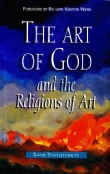

Art of God the book
...............
25 Quotations from The art of God

chapter 1 ‘What is Creation?’

What is Creation?
1.‘Today is the day of creation.  Today thousands, or is it millions, of people draw breath for the first time.  Countless animals, bugs and plants have their first hours of life.  And within each created being are capacities waiting to be discovered: to feed, to reproduce, to enjoy in some fashion, and to work.  Each creature will change the world before it dies.  And the human creatures, makers, meddlers and menders, will change the world very much.  This is creation, an explosion of activity, and it starts today.
‘Does this view of creation seem surprising?  We are so used to peering at it down a long time-tunnel that we forget how artificial, and how misleading, this telescopic image is.  A time-tunnel, however good our vision, implies a loss of focus.  'Creation' can safely occupy the romantic distance, and our imaginations, strengthened by this or that dogma, can fill it out as they please.  But creation is what is, all around us, the extraordinary, super-ordinary and just plain ordinary, the unstoppable, teeming life of the planet, the worlds and stars.
‘It is true that Adam's history book had fewer pages in it than ours.  The world he inherited had not been complicated by the mistakes of forbears.  The air was fresher! But in important respects, creation was neither older nor younger than it is for us. Our own trees, animals and people are pretty well brand new. Our mountains are antiques, just as his were, and as they should be. Like us, Adam had only today and yesterday. His yesterday was unchangeable, just as ours is.  His today was open, but conditioned by yesterday, just as ours is.  For practical purposes, we have no more and no less time than he did: we all  have today; and creation consists in what we can do with today.’ From chapter 1

2.‘Let me tell you where I want to get to in talking about Creation: and then we will see how much is in the way.  We need to arrive at a sense that the things in the world matter; people, objects.  Without that, art as it has been given to us is frustrated.   If I mention the name 'Cezanne', for example, we will think of someone to whom things in the world, apples, still-life objects, landscape, light, mattered intensely….  
‘The understanding of things mattering that we are after is of a particular kind.  If things matter because God made them and cares for them, then they matter in a virtual infinity of aspects; and they also matter as a whole.  As moderns, we characteristically substitute for this general sense that things matter for themselves (their own right to be there, and to tell us their story, which is historicially one of the main stimuli of art), the utilitarian idea that things can only matter for something.  Cezanne, on this understanding, was not interested in apples as apples, but because they were spherical, or a bit more difficult to paint than spherical!’ …
‘When we look at fellow human beings, it is becoming increasingly hard to see them as whole persons… The person, who can be addressed as a whole, is in danger of falling apart.  If, on the other hand, we see things through the eyes of creation, everything re-integrates.  We see things not as the projections of our own concepts, but as truly other to ourselves, because in some sense they are owned and vouched for by a personal God.  And that is where encounter with them starts to get exciting.’

3. ‘Cosmology and Culture
The impression is sometimes given by scientific writers that time can now be observed in an unbroken visible track, from our own times, back through Darwinian evolution, to the Big Bang, with no stations or derailments on the way, neither Garden of Eden, nor Fall and Curse.  But this description, mostly in the form of chemistry and rather large numbers, of how we got here, should not be confused with explanation, that is to say, with saying what we are and why we are here.  No kind of numerical explanation can in any way anatomise the pope of Velasquez, and say what makes him so humanly human.  For that we must look to issues like creation, corruption, and calling.  But these issues do not somehow hang in the air, separate from genetics and other aspects of the pope's human anatomy and biological history, which ceased at death.  If those 'theological' characteristics are there, they are there as part of his human history as well.  If being 'created' and 'fallen' is part of his character, it is part of his (distant) history as well.  The Big Bang theory, while so appealingly making a front door to history, must not be allowed to be a juggernaut, destroying every other concept, as if it provided any sort of explanation for the issues that culture has unearthed over centuries.   A grand unifying theory of physics is still only physics; there is a physics of this book, and every part of culture, which in no way explains what it means or why it is here.’
4. ‘Third unquiet voice: the status of the Bible
Our discussion of 'history' in relation to the Creation will have brought to the surface the issue of the Bible's status.  Without arguing the issue, it may be productive to remind ourselves that we also have a choice here.  We can restrict our understanding of the world to that which science can ascertain; but then our art also must be confined to the certainties - and uncertainties - of a scientifically mediated nature.  Meaninglessness will be a 'fact' of reality.  Absurdly, a sense of meaninglessness is in practice not a condition that favours existence, certainly not human existence, which perhaps makes it rather a doubtful 'fact'.  Alternatively, we can recognise that there is much that we need to know that science cannot tell us, which is nonetheless 'fact', but communicated by God in the way that persons do communicate, by word and act.  This may help us to a more open and personal reading of the Creation.’

Quotations from Chapter 2:
5) Art as subduing
‘When we bring these sorts of issues, of freedom and restriction, to the Bible, what do we find?  Starting with the first chapter of Genesis, we find, before we encounter any restrictions, humans placed in a world which needs 'subduing' (verse 28, the command to 'fill the earth and subdue it'). That is something we can relate to.  As in so many adventure stories, personal identity is to be discovered as we tackle a task.  We become human as we get going.  The world is not a static display, with no room for us except as admirers.  It is more like a child's box of bricks, or Picasso's junkyard, waiting to be assembled.  'Subdue' implies mind over matter, the human will organising, and, it is implied, pacifying, something unruly, which is not yet what it should be.
But does 'subdue' imply making it whatever we like?  This may be where modern ideas of creativity and the Bible begin to diverge (and we are only on verse 28!).’
6) Art as naming
‘…The process of naming, as Genesis frames it, is extremely helpful in freeing us from a view of knowledge, and of art, that lurches between the poles of objective (and obedient) or subjective (and creative).  There is something almost disturbingly creative in Adam's activity.  Whatever name he chooses, God will stick with. The name is the man's choice.  He commands it, and thereby makes some boundaries round the creature's identity.  But although his personal understanding and creative powers are involved,  in thinking up appropriate names, (as in the punning name for 'woman'), it would be futile if his naming was arbitrary.  It would also have been very exhausting!  Anyone naming would soon run out of arbitrary labels.  The story seems more to suggest that he studied the creatures, so that the names could say about them something that he had observed.  There is no division here between creativity and objectivity, because one is a necessary response to the other.’
7) Art as knowing
‘…If it is true that as creatures, we have been made to be always finding out, but never knowing completely, that gives a good reason for art.  Art is a way of knowing, satisfying but incomplete, from where we are, and this is the boundary, not just of art, but of all knowledge.  No-one, neither scientist nor guru, is going to crack the final code, and make further attempts to understand a waste of time.  No-one will bust us out of the prison of partial, creaturely knowledge, to gain the light of universal truth glimpsed outside.  For then we would indeed be 'as God' - and have responsibility for it all.’
8) 'The man has become like one of us, knowing good and evil' (3: 2, REB).  Unfortunately, unlike God, he was not always so good at distinguishing the two.  From that time, there comes into knowledge an issue of discernment.  Good and bad must be discriminated in their different disguises, and we, the viewers, can be as deceived as those we study.
There never was a universal fulcrum of knowledge, for Adam, for Aristotle, or for anyone.  But now, added to creaturely limitation, there is sinful partiality.  Knowledge has become something of a thieves kitchen, with no arbitration and everyone (all the religions and philosophies) laying claim. For art, this means not that we abandon the search for truth, but that we recognise how far ourselves we are implicated in untruth.  We enter the art gallery, metaphorically, on our knees.
9) Conclusion
‘The consonance between art and nature that would create harmony instead of discord, in lifestyle and culture, comes about not by copying nature, but by a restoration of the human mind to the kind of life and understanding that it was intended to have.  The unity between us and nature is focused on Christ.  This is why, in the end, we can confidently look for a creative complementarity between the works of humankind and the works of God.  The best architecture is, in a sense, not at all like nature; but it fits with it as the appropriately human complement…’
Chapter 3 Natural Art
10) ‘What is the natural art we are referring to?
I am thinking of pots, and things like that - and flower arrangements, and cakes: ordinary things that make life good.  Natural art, like many of the good things of life, should be easy to find but is oddly elusive.  Unlike well-made, mass-produced electrical goods, which it is almost impossible not to buy, it has to be sought out.  Finding it, indeed, is part of its delight. It is the exotic art of  Indian crafts imported to the West, in boxes, bowls, cushions, jewellery; each piece suggestive of an interesting story of origin, a picture of markets, of shadowed huts and brown skin in sunlight, of family, costume and traditions, (but not the factory).  It is the art of pottery brought home unscathed from a Portuguese market; souvenir gourd-vessels or baskets from Africa or South America.  It is the universal art of the museums, the kinship of the craftsman across many centuries and cultures: English decorated slipware from mediaeval times, Islamic bronze pots, Roman wall paintings, coins, and altars.  It is also that which it is the objective of many a craft club to produce, and many a harassed Christmas shopper to find.  But as has been lamented at least since the day of Ruskin, the conditions of industrial life, and impersonal market economics, are as corrosive to natural art as the smogs are to the Parthenon stones, or petrochemical plants are to Venice.’
11) 'It can't be anything else, but how was it arrived at at all?'  These, then, are the features of natural art, art which is the human counterpart to the works of nature, something both normal and utterly mysterious.  
12) ‘The paradox of the artist, the originator, also being servant to the work has an instructive counterpart in the human giving of life.  Just like a parent, the artist may at times be exhausted, emptied out; but see in the health and individuality of that which has been produced a proper transfer of energy, a fruit of labour. And just as the typical characteristics of the well-loved child could be described as healthy (or tended) form, character and provision of adornment, so also the natural work of art's content could be described as form, character and adornment.’
13) ‘What is the transcendent truth that the craftsman stumbles upon, and that his or her work conveys?  It seems to be the extraordinary truth that our freedom is part of a bigger will.  The things we do freely, at great cost, which we have never dreamed of before, turn out to be, when we have done them, things that had to be done. Part of this is that the rightness of our pot, or picture, is something so outside ourselves that it is as if we never thought of it, but it was there all along.  This may account for the fact that not doing art is far more painful than doing it.  There is a sense of so many things that are there not having been done.  Bringing things to birth is rather less under one's personal control than our normal concept of autonomous 'creation', but it is probably a lot nearer the reality of creative activity.
‘But another part of this sense of our art being part of a bigger will has a parallel with nature.  In nature, the birds and beasts, rocks and trees, have the quality of being utterly themselves, and yet utterly willed…’  
14) ‘Even where you would least expect it, nature presses in.  Today, travelling in an aesthetically hapless Midlands city, I see a tall block of flats, poorly built, almost colourless, a repetitious pile of square windows with pinkish surrounds against bare concrete. It looks marvellous.  Low cloud, or fog, depending on your frame of mind, makes it almost melt into the grey winter sky, while a pale light, reflected in the windows, faintly glows, in gradual counterpoint of glass against wall, as the building rises. This building should not look good, but it does.  Nature is witness both against it, in its loveless monotony, and for it, as a wonderful reflective surface for light.’

15) ‘You could call the aesthetic language of nature a kind of 'law'.  This is not an imposed set of rules, but simply those energies that situations seen visually disclose.  It is no one's fault, for example, that a rectangular frame sets up certain dynamics, so that a mark placed within it will appear to be stable, falling, rising, leaning, depending on where it is put.  This language simply derives from our being upright creatures in a gravity-defined world.  Sometimes we react as if there was something conspiratorial or authoritarian about these given languages, but it is healthier to regard their givenness as the external code that makes communication possible.  We do not have to prove that all such signs mean exactly the same for all times and places, to see that they do have a remarkable communicability.  Art is, after all, rather easier to teach as a universal language than English or Esperanto’.

16) ‘For Titian, the language of natural art was simply a means to an end, rather as this sentence is to me as writer.  I have a duty to organise it in its classical form, of subject, verb and object, otherwise it will either make little sense, or you, the reader, will be distracted by what seems a blatant omission.  Within the classical form, on which the partnership between writer and reader rests, there is of course considerable latitude to play and otherwise make exceptions, provided that the central agreement does not break down.  You want my language to be transparent, so that it does not get in the way, and you can think through it to my meaning.   The final comma, and the artist's final touch, releases the work to be a vehicle for meaning, which all being well will speak back to the author or artist as well.
‘However with much modern work, that agreement has broken down, so that the language becomes as much the subject of the work as what it may be trying to say.’       
Chapter 4 Spiritual Dynamics of Art
17) ‘Every monarch needs his props, the wealth and magnificence which convinces him and his subjects of his own glory.  But the post-Enlightenment 'monarch', that is, me or you, the newly liberated autonomous individual, also needs his props; to help convince him that he is no longer a creature and that he alone shall rule.  His props take the form of an artificial world of cities, of inner chambers which no daylight ever enters, of a mediated world which has neither touch nor smell; and this is reinforced by images which blur that outside world, and bring assurance that nothing in it is really real, or can offer any resistance.  Therefore even his most 'spiritual' art, supposedly concerned with the world beyond, may well be designed to reinforce the self, and give no hint that externality means accountability and judgement.’
18) ‘A different music:  the temptation, when we think of art, is to think that the Bible's music is the wrong music, that someone has brought the wrong music to the concert and is trying to play it in opposition to the melody the rest of the orchestra has agreed to play.  The rest of the orchestra only wants to listen to the good music of art, the music of power, attractive power, without responsibility.  It does not occur to them that for irresponsibility they have traded significance; that for unaccountability they have gained irrelevance.  But those who start to listen to the wrong music find something in its notes, alongside the warnings, that gathers art again to the centre; it is a music that at once diminishes art, and amplifies it out of triviality.’
19) Nature not an idol ‘So nature can be idolised, but it is not in itself an idol.  As an idol it works better, if we may put it so, when like tropical islands it is far away.  But present nature is a different proposition.  It has a way of reminding us that we are merely human, that we are vulnerable creatures, not completely in control.  We might even not be God.  As such, nature is God's own satellite television station, broadcasting primary theological truth, twenty-four hours a day.
‘The excitement of nature should be, not in offering it rule over our lives, but in the anticipation it gives of something greater.  Of course it does not prove there is a God.  On the contrary, nature is there, among other things, to make the fact of God blindingly obvious.  It is that obviousness which shows what a 'darkened understanding' we have, as St Paul put it.  .  This is nothing to do with romantic experiences of nature, visits to the Lake District etc., though they may help.  If one considers St Paul's experiences of nature, of sea-storm and desert, which would hardly have encouraged sentimentality, it is the more striking that he writes:
'For what can be known about God is plain..., because God has revealed it...Ever since the  creation of the world his invisible nature, namely his eternal power and deity, has been clearly perceived in the things that have been made. So they [that is, people in general] are without excuse'  (letter to the Romans,chapter 1, verses 19-20).
It was not a tamed, prettified nature he was writing about, but a nature that can give us trouble.  And it is this nature that speaks of the power and the deity, the godness of God, for it is a fact that it gives him no trouble at all.  
20) There is no neutral art-free reality
Most people would not, however, agree with the apostle … that from nature God's existence and his power are obvious.  If they were intended to be so, something has gone wrong.  The problem is that we do not just have nature.  We have mediated nature, nature mediated by Gauguin, by Monet and Cezanne, by economists and agronomists, by developers and anti-developers, by Chinese, Hindu and African religions, and even in their own dry way, by theologians.  The actual stuff is there to touch, of course; no-one mediates touch, but in the grown-up world where decisions have to be made, priorities allocated, and values decided, nature is subject to philosophy.  Primary experience is already coded before it happens.

Another way of saying this is that object (nature) is largely subject to image (concept, philosophy, religion).  This is just a fact about perception.  We dig and delve with ideas.  We find what we expect, sometimes less, and sometimes more.  The Americans, looking at the moon, see nature under a strong concept 'mineral wealth'.  They may well find what they are looking for.  There may be other things about the moon which however, lacking a concept for it, they will miss.  Practical concepts, in the absence of public belief in God, have a way of displacing poetic ones.
Now we need to put together the two considerations, both that nature is mediated to us by images and ideas, and that nature is theologically significant, charged with the most important message, save for the gospel itself, that we shall ever hear.  God's message through nature is entrusted to ideas.  God does have other means at his disposal.  Paul was blinded by a light brighter than the midday sun; and there is the word of the gospel itself.  But the mediation of nature is still critical.  In whose interests is this mediation being managed?  God has no control over it, or at least he is not often consulted.  Is it being managed by a world in rebellion against him, concerned precisely to deny his 'eternal power and deity'?
21) ‘As we have said, nature is a contested area in our relationship with God.  When we have grown used to thinking of it like our back garden as something we simply own, and which we can see as we please, to call it a contested area sounds at first alarmist and religiously hysterical.
But that is so only if the God-question is left out, and if there is no panic on.  But if the main issue of existence is not our comfort in this life, but a board-room battle for the running of the universe, then we are intensely involved in a squabble for every part of the property, in which our ability to define it becomes a tactic in our negotiations.  We should also admit that another reason we are so relaxed about this issue is that for hundreds of years our Western vision of reality has been informed by Christian ideas, and so our 'neutrality' is already heavily impregnated with truth.  One has only to compare English landscape painting to Japanese, to see how even Turner's art (which one might normally contrast with that of a professed Christian such as Constable) is deeply founded in Christian realism’.
22) Perception and Postmodernism
‘There is a longstanding suspicion of claims to perception.  But even in a court of law, where suspicion reaches levels undreamt of even in French postmodern philosophy, it does not follow that because some witnesses tell lies, or imagine things, all do so.  The fact that there is bias in the artist's viewpoint does not mean that nothing the artist has to say has any relation with truth, or that the process of truthtelling itself is unsatisfactory.  There could, as we have said, be possibility without performance.
‘The artist John Constable, who thought deeply about how to relate to the Creation, sees the issue not as a structural problem, of whether contact with the real world can be made, but as a moral one, of why such contact is not made more often.  In fact, he is not too surprised morally, because he understands such difficulties as due to the fall of our human nature.  That knowledge has a moral component is hardly an unexpected idea.  It is obvious that the kind of insight with which we are concerned in the arts requires honesty, at least in that area, to attain it.  It is obvious too that perception of truth only happens when a person is willing to accept the cost of whatever responsibility the truth brings upon him.   And it is obvious that we are not truth-telling creatures, at least not easily to our own disadvantage.  The question is not whether my perception works, but whether I work my perception.
‘As Constable so beautifully expresses it:
We are no doubt placed in a paradise here if we choose to make it such. All of us must have felt ourselves in the same place and situation as that of our first parent, when on opening his eyes the beauty and magnificence of external nature and the material world broke on his astonished sight intensely, with this difference: he was created at once in a perfect state, in full possession of all knowledge and mental perfection, could even call things by their names, and know what it was he saw.  The gradual perception of these things to us in our less perfect state, makes them have less effect on us, but it ought not.   (Discourses, R.B.Beckett ed., Suffolk Records Society, 1970, p.73)
‘Constable leaves aside the question as to whether the world itself is in a less perfect state than it was, to point out that perceptual dullness is a consequence of spiritual barriers. In that little phrase 'but it ought not', he signifies that humankind in its redeemed state should have those full powers of perception restored.
‘The process of attention, then, is good, but the manner of applying it may not be.  A very different conclusion has been drawn by postmodern philosophy, that the process itself is faulty and necessarily biassed.  But that view, as is well known, fails through incoherence: it ends up doubting itself.  It is of course a powerful polemical tool to suspect everybody; to say that Titian can only see 'as a man', and Artemisia Gentileschi can only see as 'a woman', and Rubens can only paint 'as a Catholic', and Claude can only paint as 'a pastrycook' and so on.  It is a tool it is remarkably easy to use, because it does not allow of any legitimate defence.  It is like the show trials of Marxist Russia or China, where someone only had to have a distant relative defined as in the wrong social class, to be 'guilty' of having deviant opinions.  Who you were was supposed to define what you thought.  None of us is in any doubt that there is some truth in this. But of course the criteria for truth have to come from somewhere.  Someone always claims to know where the truth lies, and to be able to evaluate bias.  There can be no such thing as bias if there is no truth, and there certainly cannot be perception of bias with no access to truth.
‘Despite the incoherence of his arguments, the postmodern bully is a familiar character in the art-critical playground, always ready to react to statements of value with the reply 'that's completely subjective' (as if subjective reactions could tell us nothing about the world) or 'you are only saying that because...' (as if a person's bias necessarily affected the truth of their argument).  It is hard not to see such loud-mouthed attacks as a form of pre-emptive defence for his own position, which is the assertion that there are no external criteria of value, -a belief that is a much prized source of personal 'freedom'.’
23) Real knowing in the Bible and art – the subjective-objective
‘A dictionary of Greek words tells us 'In the N.T. ginosko, know, frequently indicates a relation between the person knowing and the object known', and describes St Paul's phrase about knowing fully and being fully known as a knowledge 'which perfectly unites the subject with the object' (Vine W.E., Dictionary of New Testament Words, London 1940, pp 298, 299). Knowledge is therefore to be seen as something on the inside, rather than an external possession, which can be held without commitment.
‘Such a view of knowledge completely reverses some of the ways we have learnt to think about art.  There has been an expectation that truth in art would be to do with fact.  The results of this view are often disappointing in terms of art.  'Photographic' or realistic painting may be accurate in terms of fact, but lack truth in that it has not engaged personally with what is represented.  The work may have cost much in time and effort, but little in terms of the cost of that vision where you allow what you see to change you.  Truth arises where there is that readiness for commitment; where in a sense the artist has 'bound' himself to what he is painting.  In modern terms, the former, photographic method is very 'objective', and the latter, personally felt method very 'subjective'.  But in the Bible's terminology of knowing, the former is not knowing at all, because there is no engagement.  The 'subjective' person is the one who has stayed within their own shell, treating the world at arm's length, and the 'objective' one is the person who has shown what usually seems an immoderate devotion to the object.  Indeed, when you look at a Van Eyck or a Vermeer, the subjective-objective categories break down: the presence of the artist is the guarantee of the presence of the object.’
24) Certainty in knowledge versus trust
The ideal of perfect certainty is at root a refusal, and a denial, of the fact that we are creatures.  To be sure we do have areas we control.  Everyone of us has parts of life we understand and are responsible for.  But to a large measure, we have to exist in trust.
The ideal of certainty puts the human creature at the centre, a little 'god' knowing everything, though in fact deprived of relationship, having only a surface knowledge of things.  Trust, however, enables us to place God at the centre, knowing only what we need to know, and thereby being freed of a great deal of responsibility, to concentrate on the relationships he has given us.’
25) ‘It does seem surprising that something as significant as truth should be loaded into the frail vessel of form.  One might imagine it should be otherwise, and that truth should never be allowed out of the safety of steel-lined propositions.  But God seems to have ordained it that truth should be touched, handled and seen as well as understood…’