

Personal history of David Thistlethwaite
I was brought up in London, the middle child of a tragically quarrelsome marriage between a half-German businessman, one of whose ancestors was once hanged in the Reformation for his beliefs (so he told me), and a half-Anglo-Irish artist who was very fond of argument. In these disputatious surroundings I learnt to look at issues from both sides, sometimes a fatal weakness.
The artistic side was stronger in me than the business, and in any case I did not value business as I should. My father did not particularly enjoy offices or factories either, being more at home in his garden or travelling, but he had a practical understanding of where wealth comes from which I still lack. I was more inclined to ‘consider the lilies of the field, which neither toil nor spin’, a saying of Christ’s which lodged itself in my mind from church, and seemed to suggest that there must be another way.
Not entirely the right God
I had my first significant encounter with God at about the age of 15, when I surrendered my life to him, and immediately felt an extraordinary sense of peace and freedom from worry. The context of this conversion was a Moral Re-Armament camp, and unfortunately I did not convert to entirely the right God, as Jesus was scarcely mentioned, and many of my then ideas about God have turned out to be false. But it was a start.
It was also at that time that the need to reconcile art and Christian faith first became a preoccupation. The Moral Re-Armament people wanted to produce an art that was ‘guided by God’, expressed their faith, and that would explain their ideas and produce conversions. This was not very far, I found later, from the desires of the Catholic Church pronounced at the Council of Trent.
My school art master, on the other hand, believed that all attempts to use art for some external purpose would result in thinly disguised propaganda, like the Socialist Realist art of the Soviet Union, which was a by-word in the 1960s for bad art.
In this dispute there were essentially two sides. There were those for whom faith came first, and if art tipped over into propaganda, that did not greatly offend them. They were more concerned with its functionality, as a means to an end. On the other side, were those for whom the true standard was art, and anything that diverted it from its central purity into propaganda or sentimentality was an abomination.
I cared, and still care very much, about the quality of art as art. Art that is merely advertising feels like an impostor, leaving the viewer feeling cheated or abused. It has no depth, and cannot last. However, if God is God, then art has to come second.
Art and faith reconciled
[But, to answer my question from the standpoint of later, if art is subject to God, that does not mean it is subject to human faith or religion. Suppose God as God of art, himself wants art that is good art? The Bible, after all, is scarcely a work of propaganda. It is disarmingly honest about the difficulties of belief and the weaknesses of nearly all the main characters. God seems to prefer truth to salesmanship.]
So, just as I longed to see my parents reconciled (which did, by God’s grace, eventually happen to some extent), so I was left also trying to overcome the pain of the split between faith and art.
The split between faith and art is normally overcome through something called ‘religious art’. I went to a school which, in its architecture, embodied the attempt to produce a pure Christian art, expressed in the Gothic style. The leading architectural writer of the time, Niklaus Pevsner, thought this architecture ‘self-conscious’, as for him, architecture embodied, and should embody, the spirit of the age. Victorian railway stations, rather than Cathedral-like chapels, were more authentic works of art. If your age is materialistic, so the argument went, so must your architecture be. This argument ruled out any art based on faith, which attempted to stand aside from the spirit of its age.
Unfortunately there was also much truth in Pevsner’s observation, visually, because to my eye a lot of religious art does have the appearance of trying too hard, and does not really embody the spirit it aspires to. Some Victorian religious painting – such as Pre-Raphaelite works – seems to me to have more of a material than a spiritual insight. It is not easy to stand aside from the currents of your own time. Admittedly, our school art master had prejudiced me against the Pre-Raphaelites: but I still think he was right.
Cambridge 1968-72
At Cambridge I encountered modernity more directly. For my first and last years I lived in modern accommodation, and experienced the sense of rootlessness, of floating in mental, rather than physical space, which is to me characteristic of all modernist buildings. I was also shocked that there seemed to be no language available in which to critique the new style. Thanks to the powerful arguments of Pevsner and his disciples, modernism was the authentic product of the age and we were stuck with it.
In studying art history, I also encountered the writings of Roger Fry, the first great British exponent of Cézanne and Post-Impressionism. Coming from a Quaker background, his taste was for the simple and austere, and he almost single-handedly had turned his nation away from its love of narrative art and emotive, or sentimental, subject-matter. For him, the ostensible subject of a painting was really irrelevant to its aesthetic appeal, though he moderated that extreme view somewhat in is later years. But essentially, he saw all art as if it was a landscape, and he were an impressionist painter, just seeing coloured forms.
I found these ideas at the same time ridiculous and threatening. They threatened me, because my own vision was very much the same, though I couldn’t understand Cézanne. I used my eyes in a similarly ‘aesthetic’ way. But it also seemed ridiculous to think that art was really cut off from meaning and from truth. I felt sure that art was more than a fine view or, if you were drug-minded, an aesthetic trip. So did Fry, but he was stuck in a Kantian frame of thought, where there was no route from the phenomenal, or physical world (paint, canvas, trees and flowers) to the ‘noumenal’ world of transcendent values. He did not want to espouse abstract art, which for its exponents provided some sort of direct route to the transcendent. So, for him, the aesthetic was stranded in limbo, exceedingly important, but impossible to say why.
So Fry left a legacy of unsolved issues; an acute sense of the value of art, but no means of explaining it.
Meanwhile, as well as studying Fry, I also became a student of Italian and Flemish Baroque art, which could hardly have been a better antidote. This was true ‘propaganda art’, art actually promoted, in some degree, under the auspices of the Roman Catholic Church’s department for the propagation of the faith, the ‘Propaganda Fide’. Here was an art which had reacted against the esoteric and interior nature of Mannerism by being uninhibitedly communicative, clear in narrative, wearing its heart on its sleeve. Fry himself had reacted strongly against Caravaggio, then newly discovered, calling him the origin of some of the worst tricks of cinematography. But it soon became clear to me that Fry’s real problem was not with narrative, but with the way the Victorians had used it, and that, if anything, was the fault of the emerging art market. Fry, I realised, had thrown out the baby with the bathwater, and narrative, and an art of symbolism, could be accepted. Not that all Baroque art was equally digestible. Saints with upturned eyes, as in Guido Reni’s lesser works, still almost turn my stomach.
Bond Street, London
After Cambridge, I worked for nearly four years in a London art dealers, getting to know at first hand some of the greatest painters. This brought up for me the question of value. It was clear that art was expensive; what was rather more amazing was that there could be so much agreement about what was worth what. Clearly aesthetics was not quite as ‘subjective’ as Cambridge thought had led me to believe. But in any case, was there a value in art beyond the commercial? Obviously so, but how could one express it in other than ‘subjective’ terms? It was clear that, in the realm of ideas, there were battles still to be fought, and I felt frustrated by the discrepancy between ‘the best thought’ and ‘the real world’.
I left London and art dealing in an attempt to get my life back on the course started, but soon abandoned, when I first surrendered my life to God. [I explain a bit more about this next phase in a couple of autobiographical pages in ‘The art of God and the religions of Art’]. I returned to Cambridge to do research and to try to understand modern art for myself.
Cambridge again
After three years, I was nearly as mad and introspective as some of the art I was studying. Eventually I ran to God again, this time through the message of Christ’s gospel. In his hands, I tried to begin again. This began a total re-think, this time with God, rather than myself, at the centre. I spent some time trying to give up art all together. ‘If your hand offends you, cut it off!’, I had realised that art had had a deeply idolatrous place in my life, and if I wanted to know Christ, it had to make way. This was not easy. My identity was so bound up with myself as priest of art, that I did not know who I really was. I still don’t! But eventually art began to re-emerge, in a subdued, but in fact more enjoyable form. I stopped hating it as much as I loved it, and just loved it.
Universities and Colleges Christian Fellowship (UCCF)
There followed more thinking, abandonment of my research (never very PhD-able), marriage to an artist (who has challenged more of my prejudices), and many struggles to try and earn money, rather than simply coin it, as seemed to happen in the art trade. Three moves after Cambridge found us in Leicester, home of UCCF, where I was given work looking after Graduate Professional Groups. About the only profession unable to organise its Christian members was the artists! (That’s an exaggeration: there was and is an Arts Centre Group). This gave excellent practice in trying to think biblically about ‘secular’ life, as well as helping me see the range of professions, besides art, of which Jesus is Lord.
I came to realise, ever more strongly, that Christ’s lordship and truth are for all aspects of art, and not just for ‘religious’ or ‘Christian’ art. There is no other God, so all art, in some measure, is from him and refers back to him. Obviously there is art that owns him, art that is full of his Spirit, and art that has a degree of demonic warping, but ‘every good gift comes from above’, as the Letter of James states.
Writing
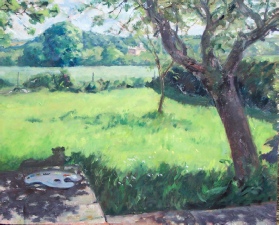
At the end of my time at UCCF I was invited to write ‘The art of God’, which took about two years in all. I have not written much since. Instead, I have been learning to paint. Painting is extraordinary. Being on the brink, every stroke, of success and failure, working with the stuff of creation in response to creation, invites a dependence on God and brings at times a sense of joy as if this is ‘real life’. Probably if I was a racing driver I’d feel the same way in a fast car. But there is something about the risk and exposure in art that peculiarly brings me closer to God – which is not to say (lest I seem to boast) very close at all. Close for me. I paint landscapes. Today it’s raining, so I’m writing.
We live in the Cotswolds, in South West England, surrounded by sheep. Sometimes this feels a bit cut off, so you are welcome to get in touch. I work for The John Ray Initiative (www.jri.org.uk), a Christian environmental charity, based in Cheltenham. (Update 2010, I am now attempting to paint full time).
D.T. 9.11.04